Concurrency
The following diagram contrasts interleaved execution on one CPU core with parallel execution across multiple cores:
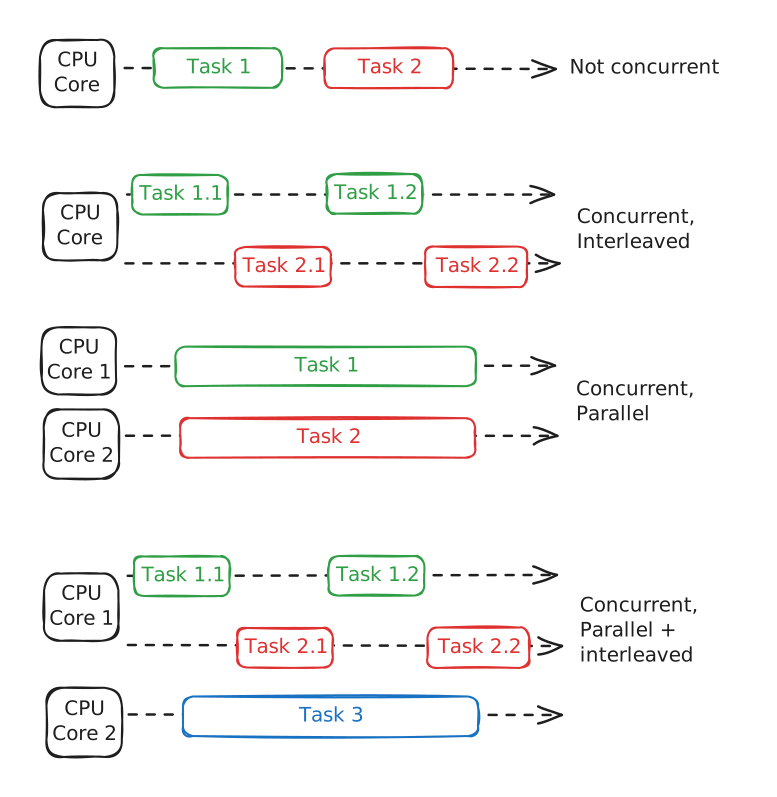
Concurrency is the broader problem of managing multiple tasks whose execution overlaps in time. It includes interleaving execution (switching between tasks) and parallel execution (running tasks simultaneously on different cores).
When concurrent tasks access the same mutable object, Shared Mutation is what makes their interleavings observable and potentially unsafe.
“Concurrency is about dealing with lots of things at once. Parallelism is about doing lots of things at once.” — Rob Pike.
Interleaving Execution
Interleaving execution allows multiple tasks to make progress on a single CPU core by switching between them.
Useful for I/O-bound workflows
Common examples include:
- Operating system thread scheduling
- Event loops
async/await- Coroutines
Parallel Execution
Parallel execution allows multiple tasks to execute simultaneously on different CPU cores or processors. Unlike interleaving, more than one task is actively running at the same instant.
Useful for CPU-bound workflows
Note on Definitions
The term “concurrency” is overloaded.
Some sources define concurrency narrowly as interleaved execution achieved through context switching. This corresponds to interleaving execution in this note.
Other sources define concurrency more broadly as managing multiple tasks whose lifetimes overlap. This makes both interleaving and parallelism mechanisms for achieving concurrency, which is the definition used in this note.
This note uses the broader definition, which aligns with Sun’s Multithreaded Programming Guide, Wikipedia’s definition of concurrency, and Rob Pike’s explanation of concurrency.
Relationship to Threads, Processes, and CPU Cores
Interleaving and parallelism describe execution patterns, whereas threads, processes, and CPU cores describe execution mechanisms and resources.
- Threads and processes can be interleaved.
- Threads and processes can be executed in parallel.
- Multiple CPU cores enable parallel execution.
- Multiple threads or processes don’t imply parallelism.
